
CCS52A1/2 orchestrate hypocotyl endoreplication and elongation via PKN1/PKN2 pathways in Arabidopsis thaliana
Keywords:
CCS52A2, Cell expansion, Cell wall, Hypocotyl elongation, Lignin biosynthesisAbstract
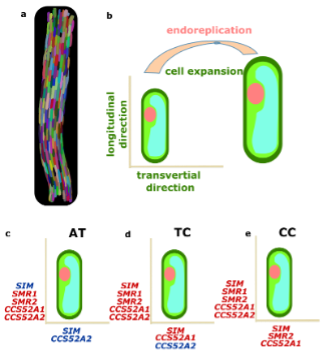
Etiolated hypocotyls undergo rapid elongation compared with light-grown seedlings, a process associated with a developmental transition from mitotic cell division to endoreplication, resulting in increased cellular ploidy. CELL CYCLE SWITCH 52A2 (CCS52A2) is a key regulator of endoreplication in Arabidopsis thaliana, functioning through activation of the anaphase-promoting complex/cyclosome (APC/C) to mediate cyclin degradation. In this study, we demonstrate that loss-of-function mutations in CCS52A2 significantly reduce hypocotyl elongation, particularly under dark-grown (etiolated) conditions. Notably, this phenotype is partially rescued in a ccs52a2 pkn1 double mutant, indicating that CCS52A2 promotes etiolated hypocotyl elongation at least in part through the PKN1 signaling pathway. Furthermore, our findings suggest that endoreplication influences cell wall composition and its downstream modifications, providing new insight into the link between ploidy level and cell wall dynamics during skotomorphogenic growth.
References
1. Vandenbussche F, Vriezen WH, Smalle J, Laarhoven LJJ, Harren FJM, Van Der Straeten D. 2005. Of light and length: Regulation of hypocotyl growth in Arabidopsis. BioEssays 27:275–284
2. Gendreau E, Traas J, Desnos T, Grandjean O, Caboche M, Höfte H. 1997. Cellular basis of hypocotyl growth in Arabidopsis thaliana. Plant Physiology 114:295–305
3. Kudo N, Kimura M, Matsuoka M. 2004. Endoreduplication cycles during hypocotyl growth of cabbage (Brassica oleracea L.) under light and dark conditions. Plant Biotechnology 21:295–312
4. Daher FB, Chen Y, Bozorg B, Clough J, Jönsson H, Braybrook SA. 2018. Anisotropic growth is achieved through the additive mechanical effect of material anisotropy and elastic asymmetry. eLife 7:1–28
5. Narukawa H, Yokoyama R, Komaki S, Sugimoto K, Nishitani K. 2015. Stimulation of cell elongation by tetraploidy in hypocotyls of dark-grown Arabidopsis seedlings. PLoS ONE 10:1–13
6. Collett CE, Harberd NP, Leyser O. 2000. Hormonal interactions in the control of Arabidopsis hypocotyl elongation. Plant Physiology 124:553–561
7. Derbyshire P, Findlay K, McCann MC, Roberts K. 2007. Cell elongation in Arabidopsis hypocotyls involves dynamic changes in cell wall thickness. Journal of Experimental Botany 58:2079–2089
8. De Lucas M, Davière JM, Rodríguez-Falcón M, Pontin M, Iglesias-Pedraz JM, Lorrain S, Fankhauser C, Blázquez MA, Titarenko E, Prat S. 2008. A molecular framework for light and gibberellin control of cell elongation. Nature 451:480–484
9. Lin W, Zhou X, Tang W, Takahashi K, Pan X, Dai J, Ren H, Xia X, Xu G. 2021. TMK-based cell-surface auxin signalling activates cell-wall acidification. Nature 599:278–282
10. Ren H, Santner A, del Pozo JC, Murray JAH, Estelle M. 2018. A subset of plasma membrane-localized PP2C.D phosphatases negatively regulate SAUR-mediated cell expansion in Arabidopsis. PLoS Genetics 14:1–27
11. Du M, Spartz AK, Gray WM. 2022. Biphasic control of cell expansion by auxin coordinates etiolated seedling development. Science Advances 8:1–13
12. Ishida T, Adachi S, Yoshimura M, Shimizu K, Sugiyama M, Hasebe M. 2010. Auxin modulates the transition from the mitotic cycle to the endocycle in Arabidopsis. Development 137:63–71
13. Wu G, Cameron JN, Ljung K, Spalding EP. 2016. ABCB19-mediated polar auxin transport modulates Arabidopsis hypocotyl elongation and the endoreplication variant of the cell cycle. Plant Journal 85:209–218
14. Walker JD, Oppenheimer DG, Concienne J, Larkin JC. 2000. SIAMESE, a gene controlling the endoreduplication cell cycle in Arabidopsis thaliana trichomes. Development 127:3931–3940
15. Vanstraelen M, Baloban M, Da Ines O, Cultrone A, Lammens T, Boudolf V, Brown SC, De Veylder L, Mergaert P, Kondorosi E. 2009. APC/CCCS52A complexes control meristem maintenance in the Arabidopsis root. Proceedings of the National Academy of Sciences of the United States of America 106:11806–11811
16. Churchman ML, Brown ML, Kato N, Kirik V, Hülskamp M, Inzé D, De Veylder L, Walker JD, Zheng Z, Oppenheimer DG, Genschik P, Larkin JC. 2006. SIAMESE, a plant-specific cell cycle regulator, controls endoreplication onset in Arabidopsis thaliana. Plant Cell 18:3145–3157
17. Wang K, Chen Y, Chen Y, Liu Z, Li Y, Chen Y, Ding L, Zhang X, Liu Y, Liu J. 2020. The CDK inhibitor SIAMESE targets both CDKA;1 and CDKB1 complexes to establish endoreplication in trichomes. Plant Physiology 184:165–175
18. Kumar N, Harashima H, Kalve S, Bramsiepe J, Wang K, Sizani BL, Jadamba L, Guan Y, Dissmeyer N, Gutierrez RA, Sugimoto K. 2015. Functional conservation in the SIAMESE-RELATED family of cyclin-dependent kinase inhibitors in land plants. Plant Cell 27:3065–3080
19. Fülöp K, Tarayre S, Kelemen Z, Horváth G, Kevei Z, Nikovics K, Bakó L, Brown S, Kondorosi É, Szabados L. 2005. Arabidopsis anaphase-promoting complexes: Multiple activators and wide range of substrates might keep APC perpetually busy. Cell Cycle 4:4084–4092
20. Lammens T, Boudolf V, Kheibarshekan L, Panagiotou S, Van Leene J, De Milde L, Van De Slijke E, De Rycke R, Inzé D, De Veylder L. 2008. Atypical E2F activity restrains APC/CCCS52A2 function obligatory for endocycle onset. Proceedings of the National Academy of Sciences of the United States of America 105:14721–14726
21. Boudolf V, Lammens T, Boruc J, Van Leene J, Van Den Daele H, Maes S, Van Isterdael G, Russinova E, Kondorosi E, Witters E, De Jaeger G, Inzé D, De Veylder L. 2009. CDKB1;1 forms a functional complex with CYCA2;3 to suppress endocycle onset. Plant Physiology 150:1482–1493
22. Willems A, Heyman J, Huysmans M, De Veylder L. 2021. The APC/CCCS52A2 E3-ligase complex targeted PKN1 protein is a plant lineage specific driver of cell division. Plant Physiology (in press)
23. Willems A, Friml J, Van de Velde K, Van de Cotte B, Van de Walle L, Van Leene J, De Jaeger G, De Veylder L. 2020. The cyclin CYCA3;4 is a postprophase target of the APC/CCCS52A2 E3-ligase controlling formative cell divisions in Arabidopsis. Plant Cell 32:2979–2996
24. Heyman J, Cools T, Vandenbussche F, Veylder LD. 2017. Tissue-specific control of the endocycle by the anaphase promoting complex/cyclosome inhibitors UVI4 and DEL1. Plant Physiology 175:303–313
25. Vlieghe K, Boudolf V, Beemster GTS, Maes S, Ormenese S, Van Isterdael G, Inzé D, De Veylder L. 2005. The DP-E2F-like gene DEL1 controls the endocycle in Arabidopsis thaliana. Current Biology 15:59–66
26. Berckmans B, Lammens T, Van Den Daele H, Magyar Z, Bögre L, De Veylder L. 2011. Light-dependent regulation of DEL1 is determined by the antagonistic action of E2Fb and E2Fc. Plant Physiology 157:1440–1451
27. Bhosale R, Boudolf V, De Veylder L. 2019. Endoreplication as a potential driver of cell wall modifications. Current Opinion in Plant Biology 51:58–65
28. Jegu T, Latrasse D, Debernardi JM, Pumplin N, Veluchamy A, Wang L, Sureshkumar S, Velanis CN, Raynaud C, Gruissem W, Thirugnanasambantham K, Delannoy E, Benhamed M, Bergounioux C, Bowler C, Balzergue S, Domínguez-Ferreras A, Schneeberger K, Fletcher JC, Ecker JR, Gutierrez-Marcos J, Jacobsen SE, Palatnik JF, Coupland G, Turck F. 2013. Multiple functions of Kip-related protein5 connect endoreduplication and cell elongation. Plant Physiology 161:1694–1705
29. Dukowic-Schulze S, Harris A, Li J, Sundararajan A, Mudge J, Retzel EF, Chen C. 2021. UV-B irradiation results in inhibition of hypocotyl elongation, cell cycle arrest, and decreased endoreduplication mediated by miR5642. Photochemistry and Photobiology (DOI: 10.1111/php.13574)
30. Bhosale R, Maere S, Boudolf V, De Veylder L. 2018. A spatiotemporal DNA endoploidy map of the Arabidopsis root reveals roles for the endocycle in root development and stress adaptation. Plant Cell 30:2330–2351
31. Urbanowicz BR, Peña MJ, Moniz HA, Moremen KW, York WS. 2014. Two Arabidopsis proteins synthesize acetylated xylan in vitro. Plant Journal 80:197–206
32. Bensussan M, Lefebvre V, Verbancic J, Yang Y, Chen X, Kronenberger J, Beauclair L, Grandjean O, Marchive C, Brunoud G, Guyon V, Boucherez J, Thévenin J, Navarro L, Bouchez D, Höfte H. 2015. Suppression of dwarf and irregular xylem phenotypes generates low-acetylated biomass lines in Arabidopsis. Plant Physiology 168:452–463
33. Perazza D, Herzog M, Hülskamp M, Brown S, Dorne AM, Bonhomme S. 1999. Trichome cell growth in Arabidopsis thaliana can be derepressed by mutations in at least five genes. Genetics 152:461–476
34. Wang S, Gu Y, Zebell SG, Anderson LK, Wang W, Mohan R, Dong X. 2014. A noncanonical role for the CKI-RB-E2F cell-cycle signaling pathway in plant effector-triggered immunity. Cell Host and Microbe 16:787–794
35. Hamdoun S, Zhang C, Gill M, Kumar N, Churchman M, Larkin JC, Kwon A, Lu H, Lee JY. 2016. Differential roles of two homologous cyclin-dependent kinase inhibitor genes in regulating cell cycle and innate immunity in Arabidopsis. Plant Physiology 170:515–527
36. Corneillie S, De Storme N, Vanhee C, Vandamme N, De Bruyne M, De Rycke R, Geelen D, Boerjan W, Vanholme B. 2019. Polyploidy affects plant growth and alters cell wall composition. Plant Physiology 179:74–87
37. Ma Y, Chuat JC, Li J, Voiniciuc C, Li H, Zhao X, Wang Y, Zhang Y, Wu J, Liu L, Wang X, Liu X, Zhang X, Wang H, Li J, Zhang J, Wang Y, Liu X. 2022. Endoreplication mediates cell size control via mechano-chemical signaling from cell wall. Science Advances, 8:eabq2047
38. Boron AK, Vissenberg K. 2014. The Arabidopsis thaliana hypocotyl, a model to identify and study control mechanisms of cellular expansion. Plant Cell Reports 33:697–706
39. Baloban M, Vanstraelen M, Tarayre S, Reuzeau C, Cultrone A, Mergaert P, Kondorosi E. 2013. Complementary and dose-dependent action of AtCCS52A isoforms in endoreduplication and plant size control. New Phytologist 198:1049–1059
40. Liu Q, Luo L, Zheng L. 2018. Lignins: Biosynthesis and biological functions in plants. International Journal of Molecular Sciences 19:335
41. Sexauer M, Geldner N, Vermeer JEM. 2021. Visualizing polymeric components that define distinct root barriers across plant lineages. Development 148:dev195123
42. Van de Wouwer D, Decou R, Audenaert D, Beeckman T, De Rycke R, Hoebeke L, Boerjan W, Vanholme B. 2016. Chemical genetics uncovers novel inhibitors of lignification, including p-iodobenzoic acid targeting CINNAMATE-4-HYDROXYLASE. Plant Physiology 172:198–220
43. Xie M, Zhang J, Li H, Wu J, Liu L, Wang X, Zhang X, Wang H, Li J, Zhang J. 2018. Regulation of lignin biosynthesis and its role in growth-defense tradeoffs. Frontiers in Plant Science 9:1427
44. Gu F, Nielsen E. 2016. Arabidopsis CSLD5 functions in cell plate formation in a cell cycle-dependent manner. Plant Cell 28:1722–1737
45. Vaahtera L, Schulz J, Hamann T. 2019. Cell wall integrity maintenance during plant development and interaction with the environment. Nature Plants 5:924–932
46. Kubasek WL, Shirley BW, McKillop A, Goodman HM, Briggs W, Ausubel FM. 1992. Regulation of flavonoid biosynthetic genes in germinating Arabidopsis seedlings. Plant Cell 4:1229–1236
47. Ohl S, Hedrick SA, Chory J, Lamb CJ. 1990. Functional properties of a phenylalanine ammonia-lyase promoter from Arabidopsis. Plant Cell 2:837–848
48. Kubo H. 2007. Promoter activity of phenylalanine ammonia-lyase gene of Pharbitis nil in Arabidopsis. Journal of Plant Biochemistry and Biotechnology 16:109–111
49. Hansen CH, Wittstock U, Olsen CE, Hick AJ, Pickett JA, Halkier BA. 2001. CYP83B1 is the oxime-metabolizing enzyme in the glucosinolate pathway in Arabidopsis. Journal of Biological Chemistry 276:24790–24796
50. Kim JI, Dolan WL, Anderson NA, Chapple C. 2015. Indole glucosinolate biosynthesis limits phenylpropanoid accumulation in Arabidopsis thaliana. Plant Cell 27:1529–1546
51. Rohde A, Morreel K, Ralph J, Goeminne G, Hostyn V, De Rycke R, Cushman J, Boerjan W. 2004. Molecular phenotyping of the pal1 and pal2 mutants of Arabidopsis thaliana reveals far-reaching consequences on phenylpropanoid, amino acid, and carbohydrate metabolism. Plant Cell 16:2749–2771
52. Sliwinska E, Mathur J, Bewley JD. 2015. On the relationship between endoreduplication and collet hair initiation and tip growth, as determined using six Arabidopsis thaliana root-hair mutants. Journal of Experimental Botany 66:3285–3295
53. Decaestecker W, Buono RA, Pfeiffer ML, Vangheluwe N, Jourquin J, Karimi M, Van Isterdael G, Beeckman T, Nowack MK, Jacobs TB. 2019. CRISPR-TSKO: A technique for efficient mutagenesis in specific cell types, tissues, or organs in Arabidopsis. Plant Cell (DOI: 10.1105/tpc.19.00454)
54. Kurihara D, Mizuta Y, Noguchi T, Higashiyama T. 2015. ClearSee: A rapid optical clearing reagent for whole-plant fluorescence imaging. Development 142:4168–4179
55. Montenegro-Johnson TD, Stamm P, Strauss S, Topham AT, Tsagris M, Wood ATA, Smith RS, Bassel GW. 2015. Digital single-cell analysis of plant organ development using 3DCellAtlas. Plant Cell 27:1018–1033
56. Wolny A, Cerrone L, Vijayan A, Tofanelli R, Barro AV, Louveaux M, Wenzl C, Strauss S, Kreshuk A, Hamprecht FA. 2020. Accurate and versatile 3D segmentation of plant tissues at cellular resolution. eLife 9:e57613
Downloads
Additional Files
Published
Data Availability Statement
All the data generated or analyzed during this study are included in this published article and its supplementary information files.
Issue
Section
License
Copyright (c) by the author(s)

This work is licensed under a Creative Commons Attribution 4.0 International License.