
Legacy effects in heathlands: Decoupling above- and belowground responses to subsequent drought events
Keywords:
Climate change, Heathlands, Microbial communities, Soil legacyAbstract
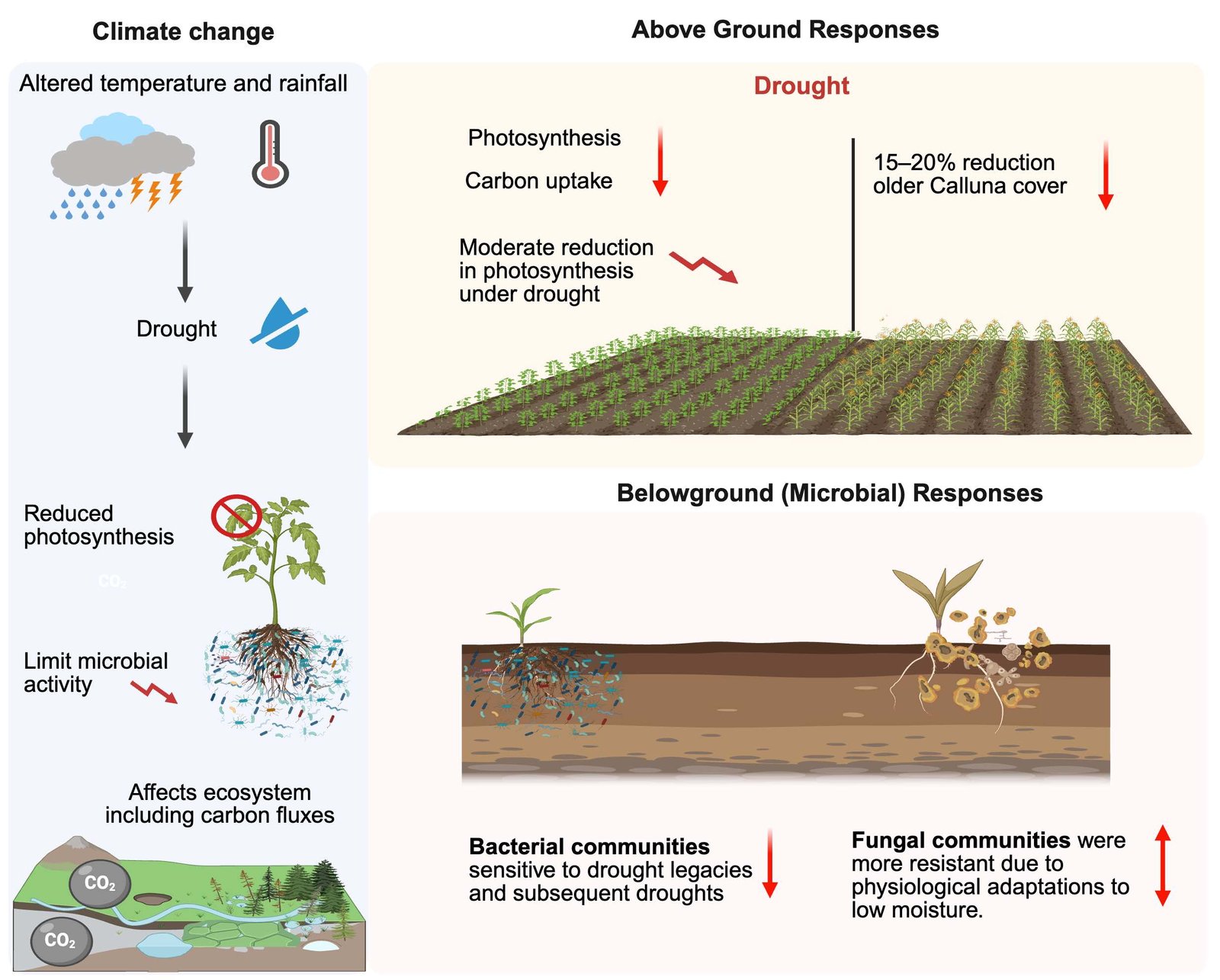
Climate change is intensifying droughts and disrupting ecosystem carbon cycles. A pivotal study reveals a critical insight: while chronic drought permanently alters the soil microbiome, these belowground legacies have a surprisingly minor effect on subsequent CO₂ fluxes. Instead, the primary driver of reduced carbon uptake is aboveground plant vulnerability, not soil microbial changes. This decoupling between resilient soils and vulnerable plants exposes a fundamental gap in climate models, which must now account for this plant-mediated risk to accurately project future climate-carbon feedbacks and inform conservation strategies.
References
1. Reichstein M, Bahn M, Ciais P, Frank D, Mahecha MD, Seneviratne SI, Zscheischler J, Beer C, Buchmann N, Frank DC. 2013. Climate extremes and the carbon cycle. Nature 500:287–295
2. Aldea J, Dahlgren J, Holmström E, Löf M. 2024. Current and future drought vulnerability for three dominant boreal tree species. Global Change Biology 30:e17079
3. Abreha KB, Enyew M, Carlsson AS, Vetukuri RR, Feyissa T, Motlhaodi T, Ng’uni D, Geleta M. 2022. Sorghum in dryland: morphological, physiological, and molecular responses of sorghum under drought stress. Planta 255:20
4. Fuchslueger L, Bahn M, Fritz K, Hasibeder R, Richter A. 2014. Experimental drought reduces the transfer of recently fixed plant carbon to soil microbes and alters the bacterial community composition in a mountain meadow. New Phytologist 201:916–927
5. Anderegg W, Trugman A, Badgley G, Konings A, Shaw J. 2020. Divergent forest sensitivity to repeated extreme droughts. Nat Clim Chang 10:1091–1095
6. Gliesch M, Sanchez LH, Jongepier E, Martin C, Hu Y, Tietema A, de Vries FT. 2024. Heathland management affects soil response to drought. Journal of Applied Ecology 61:1372–1384
7. Gliesch M, Sanchez LH, Boreel K, Tietema A, de Vries FT. 2025. Long‐term drought persistently shifts plant and soil microbial communities but has limited impact on CO₂ fluxes under subsequent drought. Global Change Biology 31:e70441
8. Canarini A, Schmidt H, Fuchslueger L, Martin V, Herbold C, Zezula D, Gündler P, Hasibeder R, Jecmenica M, Bahn M. 2021. Ecological memory of recurrent drought modifies soil processes via changes in soil microbial community. Nat Commun 12: 5308
9. Yang X, Zhang Y, Zhang X, Wang Y, Liu X, Liu M, Xiao Y, Wu J. 2025. Soil microbiota from warmer and drier grasslands are more vulnerable to drought stress. Global Change Biology 31:e70507
Downloads
Published
Data Availability Statement
The authors have nothing to report.
Issue
Section
License
Copyright (c) 2025 by the author(s)

This work is licensed under a Creative Commons Attribution 4.0 International License.