
The molecular machinery of insect herbivores for detoxifying plant chemical defenses
Keywords:
Herbivore detoxification enzymes, Insect detoxification, Insect-plant interactions, Plant secondary metabolites, Xenobiotic metabolismAbstract
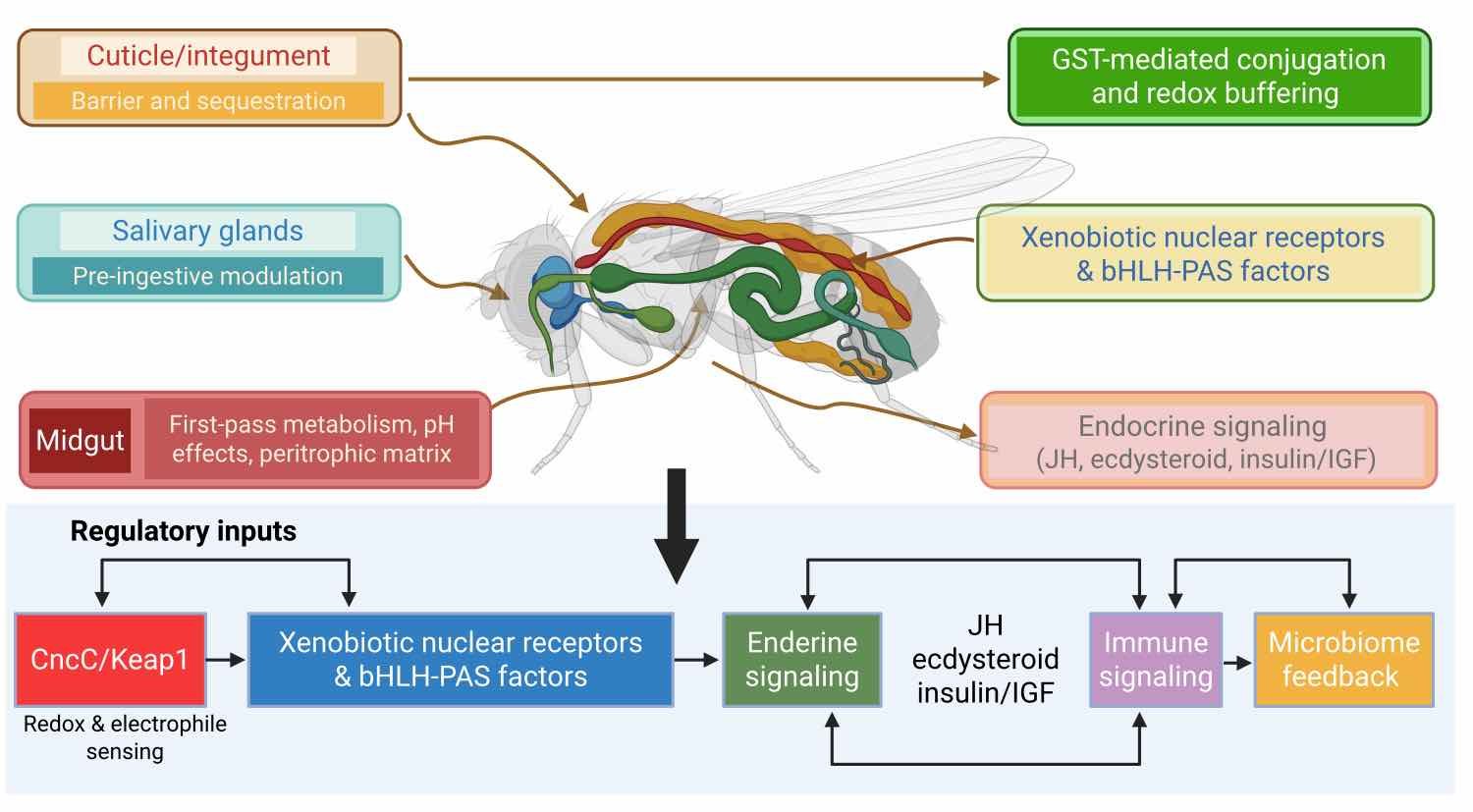
Insect herbivores have evolved a sophisticated molecular machinery to survive and thrive on chemically defended plants. They employ coordinated, multi-layered detoxification strategies that include host-encoded enzymes, transport systems, and context-dependent contributions from symbiotic microorganisms. This review synthesizes current mechanistic and evolutionary understanding of how insect herbivores deploy their integrated detoxification “machinery” that enables survival and feeding on chemically defended hosts. At the molecular level, detoxification is performed by large, evolutionarily dynamic families of cytochrome P450 monooxygenases, glutathione S-transferases, carboxylesterases, and UDP glycosyltransferases, which functionalize, conjugate, and excrete plant allelochemicals. This biotransformation architecture is functionally analogous to xenobiotic metabolism but operates as a network phenotype, subject to pronounced tissue-specific, developmental, and dietary inducibility. Comparative genomics and functional genetics have shown that host specialization and rapid adaptation often result from gene family expansion, neofunctionalization, and tissue-specific expression, driven by regulatory rewiring and frequently shaped by transposable elements and structural variation. Importantly, the same molecular modules that detoxify plant allelochemicals also intersect with insecticide resistance, creating predictable and mechanistically grounded cross-resistance risks in agroecosystems. This review provides a systems-level mechanistic understanding of insect detoxification across major phytochemical classes, highlights regulatory, spatial, and evolutionary principles, and proposes an integrative framework that links metabolic networks, ecological context, and spatially resolved multi-omics to prioritize future research.
References
1. Mello MO, Silva-Filho MC. 2002. Plant-insect interactions: an evolutionary arms race between two distinct defense mechanisms. Brazilian Journal of Plant Physiology 14:71-81
2. Afroz M, Rahman M, Amin R. 2021. Insect plant interaction with reference to secondary metabolites: a review. Agricultural Reviews 42:427-433
3. Jeckel AM, Beran F, Züst T, Younkin G, Petschenka G, Pokharel P, Dreisbach D, Ganal-Vonarburg SC, Robert CAM. 2022. Metabolization and sequestration of plant specialized metabolites in insect herbivores: Current and emerging approaches. Frontiers in Physiology 13:1001032
4. Beran F, Petschenka G. 2022. Sequestration of plant defense compounds by insects: from mechanisms to insect–plant coevolution. Annual Review of Entomology 67:163-180
5. Mithöfer A, Boland W. 2012. Plant defense against herbivores: chemical aspects. Annual review of Plant Biology 63:431-450
6. Zhang Y, LI J, Wan H. 2019. Research progress on the relationship between host detoxification metabolism and insect microbial symbionts. Chinese Journal of Pesticide Science 21:729-735
7. Shakeel M, Muhammad A, Li S, De Mandal S, Xu X, Jin F. 2022. Insect microbiota and host immunity: An emerging target for pest control. In New and Future Development in Biopesticide Research: Biotechnological Exploration: 261-280
8. Schuman MC, Baldwin IT. 2016. The layers of plant responses to insect herbivores. Annual Review of Entomology 61:373-394
9. Heidel-Fischer HM, Vogel H. 2015. Molecular mechanisms of insect adaptation to plant secondary compounds. Current Opinion in Insect Science 8:8-14
10. Schweizer F, Heidel-Fischer H, Vogel H, Reymond P. 2017. Arabidopsis glucosinolates trigger a contrasting transcriptomic response in a generalist and a specialist herbivore. Insect Biochemistry and Molecular Biology 85:21-31
11. Jeschke V, Zalucki JM, Raguschke B, Gershenzon J, Heckel DG, Zalucki MP, Vassão DG. 2021. So much for glucosinolates: A generalist does survive and develop on Brassicas, but at what cost? Plants 10:962
12. Birnbaum SS, Rinker DC, Gerardo NM, Abbot P. 2017. Transcriptional profile and differential fitness in a specialist milkweed insect across host plants varying in toxicity. Molecular Ecology 26:6742-6761
13. Li X, Schuler MA, Berenbaum MR. 2007. Molecular mechanisms of metabolic resistance to synthetic and natural xenobiotics. Annual Review Entomology 52:231-253
14. Lu K, Song Y, Zeng R. 2021. The role of cytochrome P450-mediated detoxification in insect adaptation to xenobiotics. Current Opinion in Insect Science 43:103-107
15. Enayati AA, Ranson H, Hemingway J. 2005. Insect glutathione transferases and insecticide resistance. Insect Molecular Biology 14:3-8
16. Bock KW. 2016. The UDP-glycosyltransferase (UGT) superfamily expressed in humans, insects and plants: Animal plant arms-race and co-evolution. Biochemical Pharmacology 99:11-17
17. Wu C, Chakrabarty S, Jin M, Liu K, Xiao Y. 2019. Insect ATP-binding cassette (ABC) transporters: roles in xenobiotic detoxification and Bt insecticidal activity. International Journal of Molecular Sciences 20:2829
18. Wu K, Hoy MA. 2016. The glutathione-S-transferase, cytochrome P450 and carboxyl/cholinesterase gene superfamilies in predatory mite Metaseiulus occidentalis. PloS One 11:e0160009
19. Thuillier A, Ngadin AA, Thion C, Billard P, Jacquot JP, Gelhaye E, Morel M. 2011. Functional diversification of fungal glutathione transferases from the ure2p class. International Journal of Evolutionary Biology. 2011(1):938308
20. McLean S, Duncan AJ. 2006. Pharmacological perspectives on the detoxification of plant secondary metabolites: implications for ingestive behavior of herbivores. Journal of Chemical Ecology 32:1213-1228
21. Wink M. 2018. Plant secondary metabolites modulate insect behavior-steps toward addiction? Frontiers in Physiology 9: 364
22. Sun R, Jiang X, Reichelt M, Gershenzon J, Pandit SS, Giddings Vassão D. 2019. Tritrophic metabolism of plant chemical defenses and its effects on herbivore and predator performance. Elife 8 e51029
23. Chen B, Zhang N, Xie S, Zhang X, He J, Muhammad A, Sun C, Lu X, Shao Y. 2020. Gut bacteria of the silkworm Bombyx mori facilitate host resistance against the toxic effects of organophosphate insecticides. Environment International. 1;143:105886.
24. Zvereva EL, Kozlov MV. 2016. The costs and effectiveness of chemical defenses in herbivorous insects: A meta‐analysis. Ecological Monographs 86:107-124
25. War AR, Paulraj MG, Ahmad T, Buhroo AA, Hussain B, Ignacimuthu S, Sharma HC. 2012. Mechanisms of plant defense against insect herbivores. Plant signaling & behavior 7:1306-1320
26. Itoh H, Tago K, Hayatsu M, Kikuchi Y. 2018. Detoxifying symbiosis: microbe-mediated detoxification of phytotoxins and pesticides in insects. Natural Product Reports 35:434-454
27. Chahine S, O'Donnell MJ. 2011. Interactions between detoxification mechanisms and excretion in Malpighian tubules of Drosophila melanogaster. Journal of Experimental Biology 214:462-468
28. Komives T, Gullner G. 2005. Phase I xenobiotic metabolic systems in plants. Z Naturforsch 60:179-185
29. Schuler MA. 1996. The role of cytochrome P450 monooxygenases in plant-insect interactions. Plant Physiology 112:1411
30. Calla B, Noble K, Johnson RM, Walden KK, Schuler MA, Robertson HM, Berenbaum MR. 2017. Cytochrome P450 diversification and hostplant utilization patterns in specialist and generalist moths: Birth, death and adaptation. Molecular Ecology 26:6021-6035
31. Li X, Baudry J, Berenbaum MR, Schuler MA. 2004. Structural and functional divergence of insect CYP6B proteins: from specialist to generalist cytochrome P450. Proceedings of the National Academy of Sciences 101:2939-2944
32. Rane RV, Ghodke AB, Hoffmann AA, Edwards OR, Walsh TK, Oakeshott JG. 2019. Detoxifying enzyme complements and host use phenotypes in 160 insect species. Current Opinion in Insect Science 31:131-138
33. Jancova P, Anzenbacher P, Anzenbacherova E. 2010. Phase II drug metabolizing enzymes. Biomed Pap Med Fac Univ Palacky Olomouc Czech Repub 154:103-116
34. Li X. 2009. Glutathione and glutathione‐s‐transferase in detoxification mechanisms. General, applied and systems toxicology. 3rd edition. Chichester: John Wiley & Sons; 2009. Vol. 1. pp. 411–23.
35. Oakley A. 2011. Glutathione transferases: a structural perspective. Drug Metabolism Reviews 43:138-151
36. Snoeck S, Pavlidi N, Pipini D, Vontas J, Dermauw W, Van Leeuwen T. 2019. Substrate specificity and promiscuity of horizontally transferred UDP-glycosyltransferases in the generalist herbivore Tetranychus urticae. Insect Biochemistry and Molecular Biology 109:116-127
37. Li Z, Cai T, Qin Y, Zhang Y, Jin R, Mao K, Liao X, Wan H, Li J. 2020. Transcriptional Response of ATP-Binding Cassette (ABC) Transporters to Insecticide in the Brown Planthopper, Nilaparvata lugens (Stål). Insects 11 280
38. Rösner J, Merzendorfer H. 2020. Transcriptional plasticity of different ABC transporter genes from Tribolium castaneum contributes to diflubenzuron resistance. Insect Biochemistry and Molecular Biology 116:103282
39. Nagy I, Tóth B, Gáborik Z, Erdo F, Krajcsi P. 2016. Membrane transporters in physiological barriers of pharmacological importance. Current Pharmaceutical Design 22:5347-5372
40. Leslie EM, Deeley RG, Cole SP. 2005. Multidrug resistance proteins: role of P-glycoprotein, MRP1, MRP2, and BCRP (ABCG2) in tissue defense. Toxicology and Applied Pharmacology 204:216-237
41. Foyer CH, Noctor G. 2005. Redox homeostasis and antioxidant signaling: a metabolic interface between stress perception and physiological responses. Plant Cell 17:1866-1875
42. Muhammad A, He J, Yu T, Sun C, Shi D, Jiang Y, Xianyu Y, Shao Y. 2022. Dietary exposure of copper and zinc oxides nanoparticles affect the fitness, enzyme activity, and microbial community of the model insect, silkworm Bombyx mori. The Science of the Total Environment 813:152608
43. Muhammad A, Zhou X, He J, Zhang N, Shen X, Sun C, Yan B, Shao Y. 2021. Toxic effects of acute exposure to polystyrene microplastics and nanoplastics on the model insect, silkworm Bombyx mori. Environmental Pollution 285:117255
44. Dietz KJ. 2014. Redox regulation of transcription factors in plant stress acclimation and development. Antioxidants & Redox Signaling 21:1356-1372
45. Levonen AL, Hill BG, Kansanen E, Zhang J, Darley-Usmar VM. 2014. Redox regulation of antioxidants, autophagy, and the response to stress: implications for electrophile therapeutics. Free Radical Biology and Medicine 71:196-207
46. Misra JR, Horner MA, Lam G, Thummel CS. 2011. Transcriptional regulation of xenobiotic detoxification in Drosophila. Genes and Development 25:1796-1806
47. Misra JR, Lam G, Thummel CS. 2013. Constitutive activation of the Nrf2/Keap1 pathway in insecticide-resistant strains of Drosophila. Insect Biochemistry and Molecular Biology 43:1116-1124
48. Hu J, Chen J, Wang H, Mao T, Li J, Cheng X, Hu J, Xue B, Li B. 2018. Cloning and functional analysis of CncC and Keap1 genes in silkworm. Journal of Agricultural and Food Chemistry 66:2630-2636
49. Yamamoto M, Kensler TW, Motohashi H. 2018. The KEAP1-NRF2 system: a thiol-based sensor-effector apparatus for maintaining redox homeostasis. Physiological Reviews 98:1169-1203
50. Amezian D, Nauen R, Le Goff G. 2021. Transcriptional regulation of xenobiotic detoxification genes in insects - An overview. Pesticide Biochemistry and Physiology 174:104822
51. Tumova S, Dolezel D, Jindra M. 2023. Conserved and Unique Roles of bHLH-PAS Transcription Factors in Insects - From Clock to Hormone Reception. Journal of Molecular Biology:168332
52. Deng H, Kerppola TK. 2013. Regulation of Drosophila metamorphosis by xenobiotic response regulators. PLoS genetics 9:e1003263
53. Schwenke RA, Lazzaro BP, Wolfner MF. 2016. Reproduction-Immunity Trade-Offs in Insects. Annual Review of Entomology 61:239-256
54. Leyria J, Benrabaa S, Nouzova M, Noriega FG, Tose LV, Fernandez-Lima F, Orchard I, Lange AB. 2022. Crosstalk between Nutrition, Insulin, Juvenile Hormone, and Ecdysteroid Signaling in the classical insect model, Rhodnius prolixus. International Journal of Molecular Sciences 24
55. Gruntenko NE, Rauschenbach IY. 2018. The role of insulin signalling in the endocrine stress response in Drosophila melanogaster: A mini-review. General and Comparative Endocrinology 258:134-139
56. Muhammad A, Fang Y, Hou Y, Shi Z. 2017. The gut entomotype of red palm weevil Rhynchophorus ferrugineus Olivier (Coleoptera: Dryophthoridae) and their effect on host nutrition metabolism. Frontiers in Microbiology 8:2291
57. Habineza P, Muhammad A, Ji T, Xiao R, Yin X, Hou Y, Shi Z. 2019. The promoting effect of gut microbiota on growth and development of red palm weevil, Rhynchophorus ferrugineus (Olivier) (Coleoptera: Dryophthoridae) by modulating its nutritional metabolism. Frontiers in Microbiology 10:1212
58. Muhammad A, Habineza P, Ji T, Hou Y, Shi Z. 2019. Intestinal microbiota confer protection by priming the immune system of red palm weevil Rhynchophorus ferrugineus Olivier (Coleoptera: Dryophthoridae). Frontiers in Physiology 10:1303
59. Chen ML, Sundrud MS. 2018. Xenobiotic and endobiotic handling by the mucosal immune system. Current Opinion in Gastroenterology 34:404-412
60. Erlandson MA, Toprak U, Hegedus DD. 2019. Role of the peritrophic matrix in insect-pathogen interactions. Journal of Insect Physiology 117:103894
61. Hegedus D, Erlandson M, Gillott C, Toprak U. 2009. New insights into peritrophic matrix synthesis, architecture, and function. Annual Review of Entomology 54:285-302
62. Li S, Yu X, Feng Q. 2019. Fat Body Biology in the Last Decade. Annual Review of Entomology 64:315-333
63. Zhang Y, Xi Y. 2015. Fat body development and its function in energy storage and nutrient sensing in Drosophila melanogaster. Journal of Tissue Science & Engineering 6:1
64. Adamo S. 2022. The Integrated Defense System: Optimizing Defense against Predators, Pathogens, and Poisons. Integrative and Comparative Biology 62:1536-1546
65. Yang J, McCart C, Woods DJ, Terhzaz S, Greenwood KG, ffrench-Constant RH, Dow JA. 2007. A Drosophila systems approach to xenobiotic metabolism. Physiological Genomics 30:223-231
66. Farina P, Bedini S, Conti B. 2022. Multiple Functions of Malpighian Tubules in Insects: A Review. Insects 13
67. Rivera-Vega LJ, Acevedo FE, Felton GW. 2017. Genomics of Lepidoptera saliva reveals function in herbivory. Current opinion in insect science 19:61-69
68. Musser RO. 2005. Insect saliva: an integrative approach. Archives of Insect Biochemistry and Physiology 58:53
69. Beran F, Petschenka G. 2022. Sequestration of Plant Defense Compounds by Insects: From Mechanisms to Insect-Plant Coevolution. Annual Review of Entomology 67:163-180
70. Petschenka G, Agrawal AA. 2016. How herbivores coopt plant defenses: natural selection, specialization, and sequestration. Current Opinion in Insect Science 14:17-24
Downloads
Published
Data Availability Statement
The authors have nothing to report.
Issue
Section
License
Copyright (c) 2024 by the author(s)

This work is licensed under a Creative Commons Attribution 4.0 International License.